Significance - Connectedness#
In this regard, Lessons 1 and 4 represent a representative section of work toward an integrative approach to linking historical knowledge with ecological, economic, and cultural systems. At greater depth, however, it would be relative to the capacity for students to be conceptually accessible regarding the clarity of representations and the cognitively heavy-dense mode of recorded delivery. For instance, in Lesson 1, (Evidence 1) discusses seeds representing Roman archaeology concerning foods on the shelves of modern supermarkets; hence, culture must be viewed historically in terms of adaptation to environmental change. This is hardly a trivial matter; rather, for historical diets to be adopted, culture is a generally studied variable referring to a coherent system. Self-reflection-based (Evidence 4) indicated from time to time that the teacher put these relations in place, and hence for the students, it was impossible to discover how these relations actually made sense to them.
This has been deepened in Lesson 4: coherence within system thinking is made manifest with analytical assistance. (Evidence 2) shows the market table Location-Environment-Trade, making the structure of the concept of Cultural Interdependence with Geography visible. Several samples of students’ work, (Evidence 3), indicate a little use of such relational reasoning. ((Evidence 1)) to the contrary presents a different emphasis on such a structure. The result may be too early in a recorded lesson, whereby a comparison through functional trade for location and environment may be lost long before it does become possible to make any sense out of such relations. With (Evidence 5), peer comments agree that comparison may better be understood if the relations are visual or verbal to a large extent because only then can this be mattered brought into the cognitive workspace by students. This may well have been the case in the cognitive domains in which the relations were made for students rather than by them.
However, this has now been posited; conceptual relations are more appropriate when their expressiveness is evident and more than one form of support is used to develop them. Further development calls for such conceptions to emerge from the students or at least be put into an empirical test. In this way, this Kind of Connectedness moves from the teacher’s coherence to an active construction of meaning on the student’s part. It can only be afforded at a later stage with certain support in moves where systemic linkages are constructed at the lowest levels. For instance, this may be development over conceptual explanation sequences: Concept maps are co-developed where students are asked to describe how environment, economy, and culture are linked and subsequently investigated at a slow pace so that each possible step of causality is introduced. This can further be elaborated in this recording: particular moments are embedded where students must reason at various conceptual levels before going further. In this sense, significance is elaborated through relational thoughts conceived by students instead of being explained by the teacher; hence, it results in a much firmer establishment of significance and greater transferability.
Significance - Cultural Knowledge#
The loss of Cultural Knowledge in Lessons 1 and 4 can be interpreted as an issue of cultural systems rather than cultural features. It was assumed in lessons 1 and 4 that the sources of food for Romans had been established, so they were evidence of culture but had been shaped by climatic conditions and trade networks, not seen as a simple common fact in history ((Evidence 3)). From this period onward, culture became dynamic in relation to the physical world; however, from some point of view (Evidence 4), it was teacher-centred in input-interactive philosophy; therefore, students did not develop an appropriate conceptual frame explaining cultural phenomena via cultural expressions.
In this regard, lesson 4 allowed students to observe that sites along the Silk Road held different cultural characteristics according to the settings in which they lived. The basis for this is given in (Evidence 2). More important, this evidence suggests that students are in positions to grasp culture through pattern-across rather than coincidence conceptions. While this would give evidence of progress toward culture-working discipline, (Evidence 3) shows that, to some extent, cultural interpretation was not given time for fitting, and thus the depth of cultural interpretation was reduced. The peer feedback (Evidence 5) also underscores the insights gained through comparison but implies that the structure provided insight, not student inquiry.
This, in turn, raised the ominous pedagogical question of whether, indeed, the students would go off to trace out the cultural interpretive system or whether they would have to follow a ready-made system of interpretation. Under these conditions, the cultural knowledge presented would remain reproductive. The essential moves toward strengthening the embedding come with slowing the interpretative move, where the framing is left open to further explanation or elaboration by learners: for example, predictability, further options, micro-comparison, etc., which may be demonstrated by a teacher after a class discussion. Cultural meaning, therefore, would move from explaining to building, which brings it closer to disciplinary concerns over historical analysis and cultural analysis.
In this regard, further lessons on the nature of cultural logic will require students first to be challenged to make tentative cultural explanations ahead of any attempt to apply models explaining privileged cultures and their modern representations. Various explanations afford the possibility of cultural logic, linking characteristics and cultural logic to doubt and discussion, so the students must consider it a real possibility. This, too, would develop at a slower pace, allowing time to question more deeply how culture was shaped by environment, economies, and belief systems before accepting any model. In this respect, I would develop the students as cultural interpreters, meaning they have to build and negotiate the meaning of culture without necessarily having to explain it to others. Therefore, many meanings of culture may be generated under cultural logic and interpreted about evidence. All these readings may lead to revising cultural logic with reasonable arguments.
Evidence#
Evidence 1 – Lesson 4 Video Snippet: Modelling the Location–Environment–Trade Framework#
Annotation:
In this segment, I explicitly model the three-step analytical framework—location → environment → trade role—by verbally unpacking each step while displaying the guided notes sheet. I move through each site systematically, pausing to highlight environmental features before demonstrating how these logically shape trade functions. I also gesture toward the PPT while narrating the causal sequence, ensuring that students understand how to apply the frame. This explicit modelling reflects my intention to make systemic cultural reasoning visible and accessible during the recorded lesson.
Evidence 2 – PPT Analytical Table: Location → Environment → Trade Function#
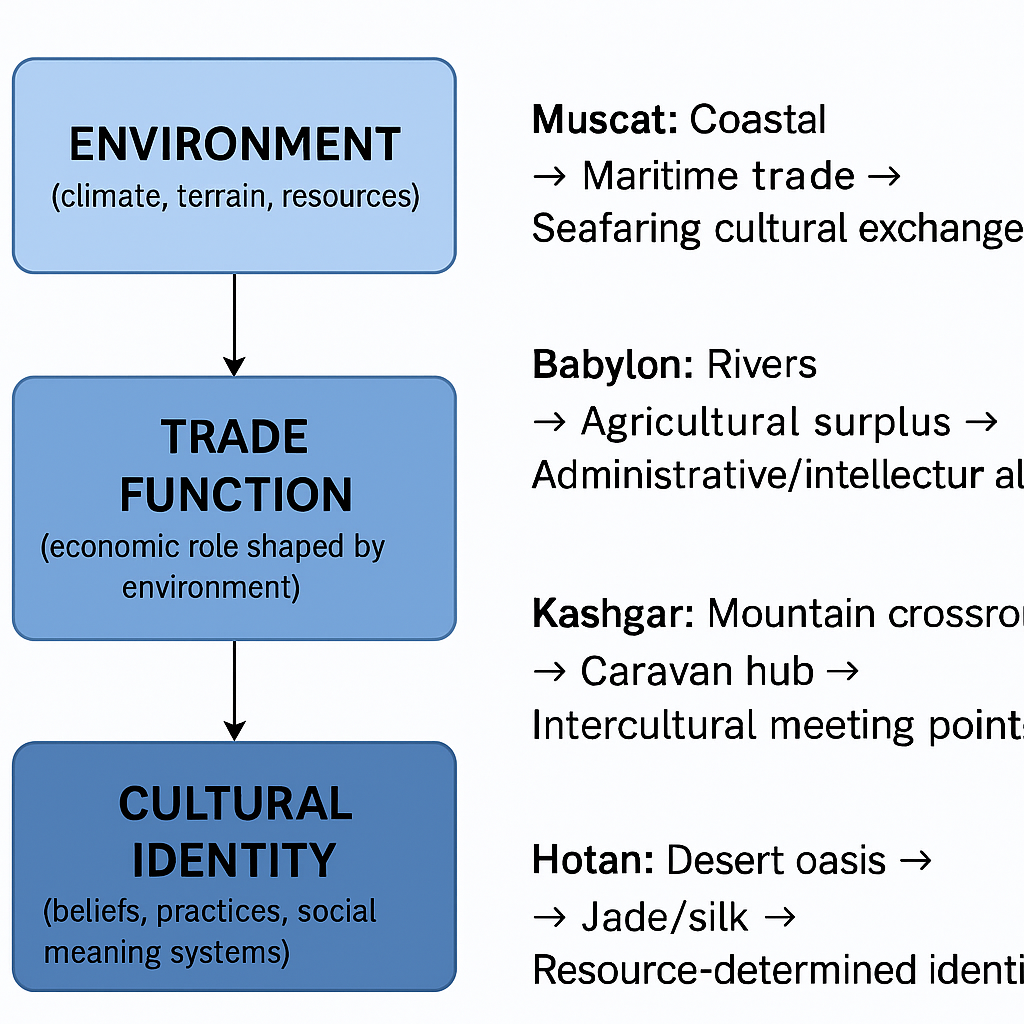
Annotation:
During the lesson, I used this table as the organising structure for my explanation. I referred to each column while speaking, drawing students’ attention to how the categories relate and showing how to transfer the same frame across four locations. I introduced the table before discussing content so that students could anticipate how new information would be categorised. Throughout the lesson, I returned to the table repeatedly to reinforce the logic of “environment shaping economic roles shaping cultural identity.”
Evidence 3 – Student Work Sample: Silk Road Guided Notes#
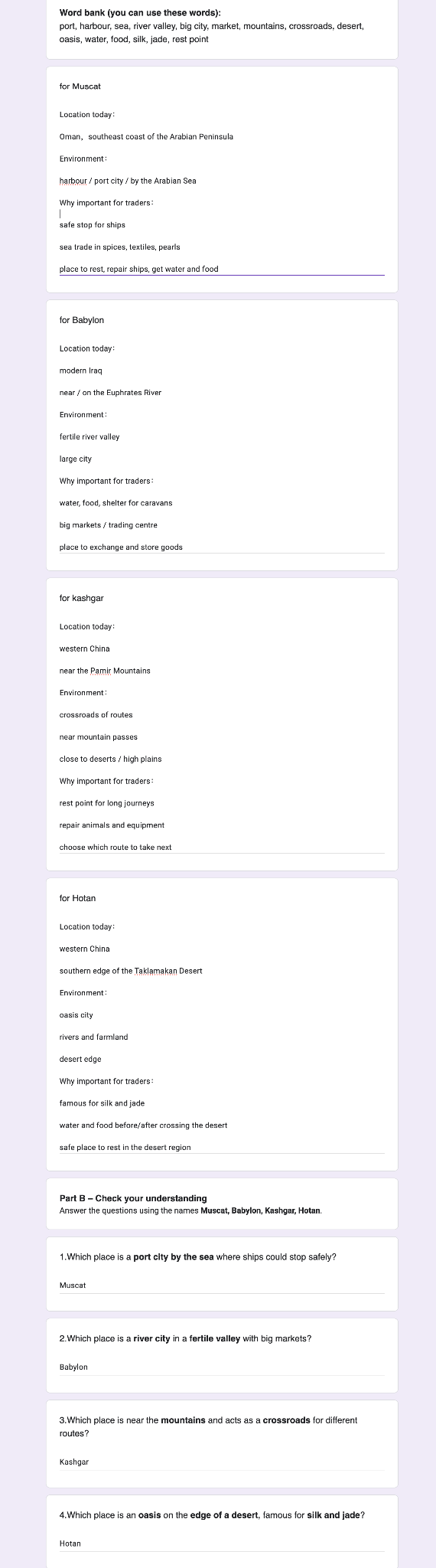
Annotation:
To support student completion of the guided notes, I verbally scaffolded each row during the recorded lesson, providing examples of environmental keywords and modelling how to infer trade functions from geographic features. I instructed students to select concise descriptors rather than full sentences, showing them how to distil information into analytical phrases. This modelling shaped the form of their responses, which can be seen in the work sample.
Evidence 4 – Self-Reflection Excerpt: Limits in Cultural Interpretation (Lesson 4)#
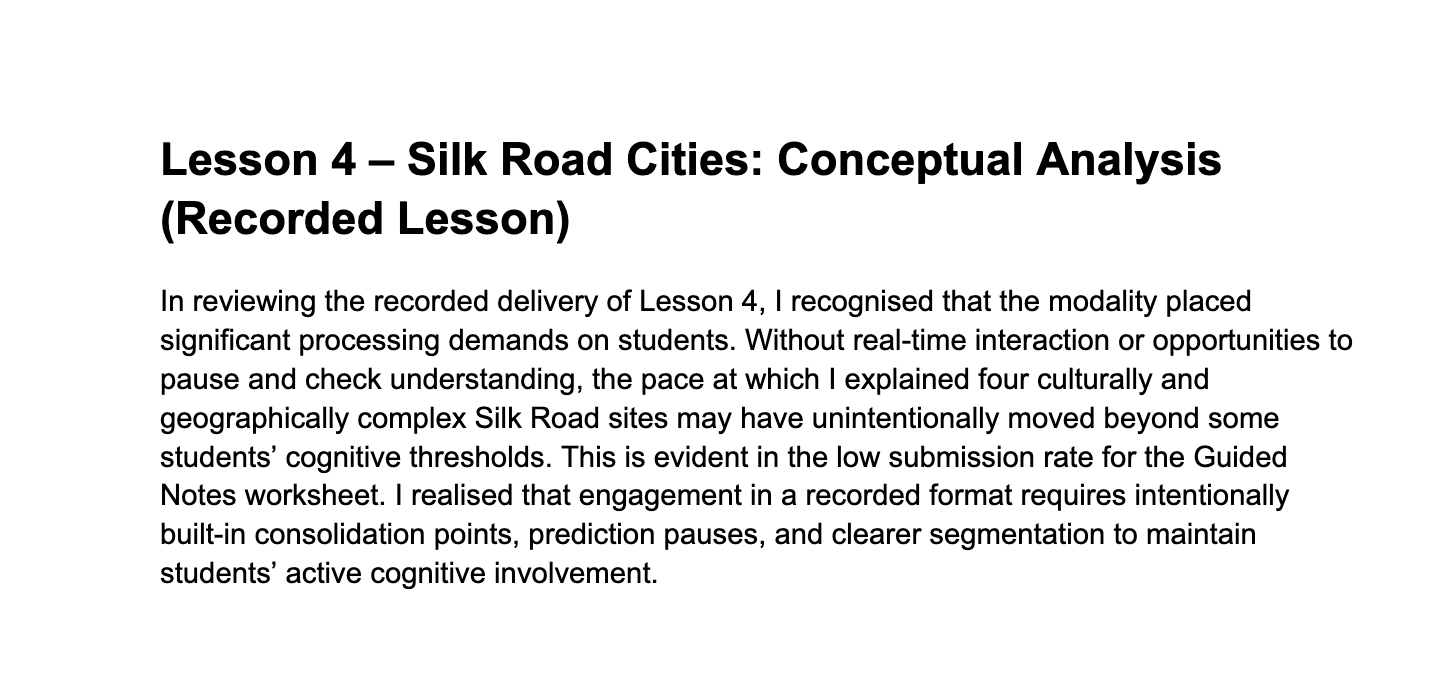
Annotation:
This reflection captures how, during Lesson 4, I delivered each cultural explanation in a rapid sequence while speaking over the PPT analytical table. I progressed through all four locations without embedding prediction pauses or student-led inference opportunities. The reflection acknowledges that my instructional choices—particularly the speed and the teacher-generated interpretive links—reduced the cognitive space for students to construct cultural meaning autonomously. This evidence demonstrates critical awareness of how my teaching practice influenced the depth of cultural reasoning available to learners.
Evidence 5 – Peer Feedback: Support for Structured Comparative Understanding (Lesson 4)#

Annotation:
The peer feedback refers to the way I structured the lesson around comparison. I guided students through each location using the same analytic categories, consistently drawing cross-site contrasts aloud. I pointed out similarities and differences explicitly during the explanation, prompting students to recognise how environmental conditions create varied cultural and economic roles. The feedback reflects how my comparative narration shaped student understanding.