Quality Learning Environment – Student Direction#
In Lessons 2 and 3, thus far, I have categorized activities thus far under Student Direction as those in which necessary structures further responsibility were included around interpretation concerning meaning and problems concerning representation on developing understanding (Evidence 1; Evidence 2). Accordingly, following the second lesson, the expectations placed on the students through the emoji-based task would reduce linguistic mediation and thus invoke more semiotic freedom for students to develop their understanding of elaborating leadership and moral ambiguity in Julius Caesar (Evidence 1). Thus, representational modality is less developed in spelling out meaning and moves toward symbolic representational modal choices for students to own the coding of the conceptual metaphor for either ambitiousness or caution (Evidence 1). Indeed, from a pedagogical point of view, reduced demand for complex representation afforded more cognitive ownership for this concept, which would have otherwise required significant mediation of expression with a teacher for EAL/D learners (Evidence 1).
This third lesson is mainly exploratory, with much emphasis on what feels like Student Direction-where an ill-defined task navigates a historical simulation with students prescribing appropriate interpretive paths and overseeing joint decision-making processes (Evidence 2). However, the critical point in the Lesson analysis is that degrees of student action are always pre-figured by the inherent task design or structural features of such tasks (Evidence 2). The absence of a unit of analysis made most decisions flowing to the few with one or more devices, demonstrating the gradation of agency (Evidence 2). Thus, if the tasks require students to participate, it is not necessarily a matter of things happening to students when the materiality is biased against one or a few students (Evidence 2). It follows from this that part of the cognitive-normative rupture of feeling is expressed through divided attention when, in fact, an instance of the expected logic of breakout sessions into conceptual processes breaks down into procedural matters. The exploratory nature of fieldwork-related activities exponentially refers to previous traces of participation patterns when rich scaffolding of cognitive distribution is lacking (Evidence 2).
Therefore, this calls for better-structural and pedagogical designs to be real Student Direction. Indeed, it will increase rotating apparatus and devices to maximize moments of collective or shareable decisions. The ask provides participation, interpretation, verification, and search for evidence roles-imbedded and thus agent upon design. However, this will also design choices for students, whether via low-level live or recorded lessons, stipulating prior judgment due to an intervention request or some other teacher input; that can indicate this particular direction of realizing student agency.
Quality Learning Environment – Student Engagement#
Seen from this perspective—from Lessons 1 through 4—dispositions toward engagement would appear to be of lesser importance than how task design, modality, and pace interact in enabling or constraining cognitively accessible entry points. In Lesson 2, the innovative emoji-based interpretation task goes beyond engagement in representational mode with the learners’ communicative repertoire (Evidence 3). At this stage, high linguistic demand was reduced, thus enabling students to consider conceptual interpretation rather than how they would express themselves and reducing their anxiety about participation (Evidence 3). Engagement thus arises from task-embedded modality in response to learner needs, particularly EAL/D learners (Evidence 3).
This reflects that interactive and exploratory modes support intense affective and cognitive engagement in Lesson 3 (Evidence 2). However, transcribed analyses show that the distribution was very unequal. The scarcity of devices implied a structural inequity in access to action and consequently to cognitive engagement (Evidence 2). Thus, observable engagement is more than a handful of enthusiastic learners; it is about equitable opportunities for all students to think about necessary task engagement (Evidence 2).
A third constraint then emerged. While a brief review of the constructed scaffold of location-environment-trade may have afforded some conceptual clarity, the sheer speed and density required to negotiate through four very complex Silk Road sites conveyed information so fast that learners could exceed their processing threshold (Evidence 4; Evidence 5). Some sections moved quite fast, as Patrick noted, and this could break engagement, not in a lack of interest but in cognitive demand due to the speed at which a recording has to be made—appearing to put engagement into passive attention rather than active mental work (Evidence 4; Evidence 6).
What these analyses thus show is that sustained engagement demands a highly intentional balance of cognitively accessible, equitably participatory structural features, and pacing attuned to learners’ processing needs (Evidence 6). The next steps include segmented content delivery, embedded prediction stops, and access to interactive tools to ensure that engagement is truly inclusive and epistemic (Evidence 6).
Evidence#
Evidence 1 – Emoji Interpretation Task as Student-Directed Representational Choice (Lesson 2)#
Annotation:
These clips collectively demonstrate how the emoji interpretation task transferred analytical authority from teacher to learner. In the first segment, the instructions explicitly position students as autonomous decision-makers by emphasising that “there is no right answer” and inviting them to select any emoji to represent Julius Caesar’s leadership qualities. This framing makes clear that representational choices are determined by students, not imposed by the teacher. (33:50–38:28)
The subsequent snippet further evidences Student Direction as learners independently select emojis and articulate interpretations of ambition, caution, and political tension. Their explanations replace teacher-provided phrasing with student-generated meaning, highlighting student control over both conceptual decisions and symbolic mapping.
Together, these clips clearly show that the task intentionally reduced teacher mediation and positioned students to direct both the form and substance of their analytical responses. (43:53–end)
Evidence 2 – Student-Directed Inquiry and Decision-Making in Minecraft (Lesson 3)#
Annotation:
These clips illustrate the extent to which the Minecraft task positioned students to direct the investigative process. In the first segment, students navigate the virtual environment, determine which NPCs to engage with, and choose pathways for gathering clues. My absence from the immediate decision-making foreground indicates that students—not the teacher—controlled both procedural and interpretive direction. (10:30–11:00)
The second segment demonstrates collaborative reasoning as students debate which keywords to select for the Bingo sheet. Their negotiated interpretation shows that criteria for evidence selection emerged through peer dialogue rather than teacher scaffolding.
Although device limitations meant that agency was unevenly distributed, the activity strongly exemplifies Student Direction through navigational choices, interpretive autonomy, and co-constructed decision-making.
Evidence 3 – Emoji Interpretation as Low-Risk Engagement (Lesson 2)#
Annotation:
This snippet shows students readily selecting emojis to represent Caesar’s traits and offering short verbal explanations. Their willingness to participate without hesitation demonstrates how the multimodal task lowered linguistic barriers and supported EAL/D learners.
This affirms the analysis claim that engagement increases when task design aligns with students’ communicative repertoires, allowing cognitive focus to shift toward conceptual interpretation rather than language production. (43:53–end)
Evidence 4 – Peer Feedback Highlighting Reduced Engagement Due to Pacing and Cognitive Load (Lesson 4)#
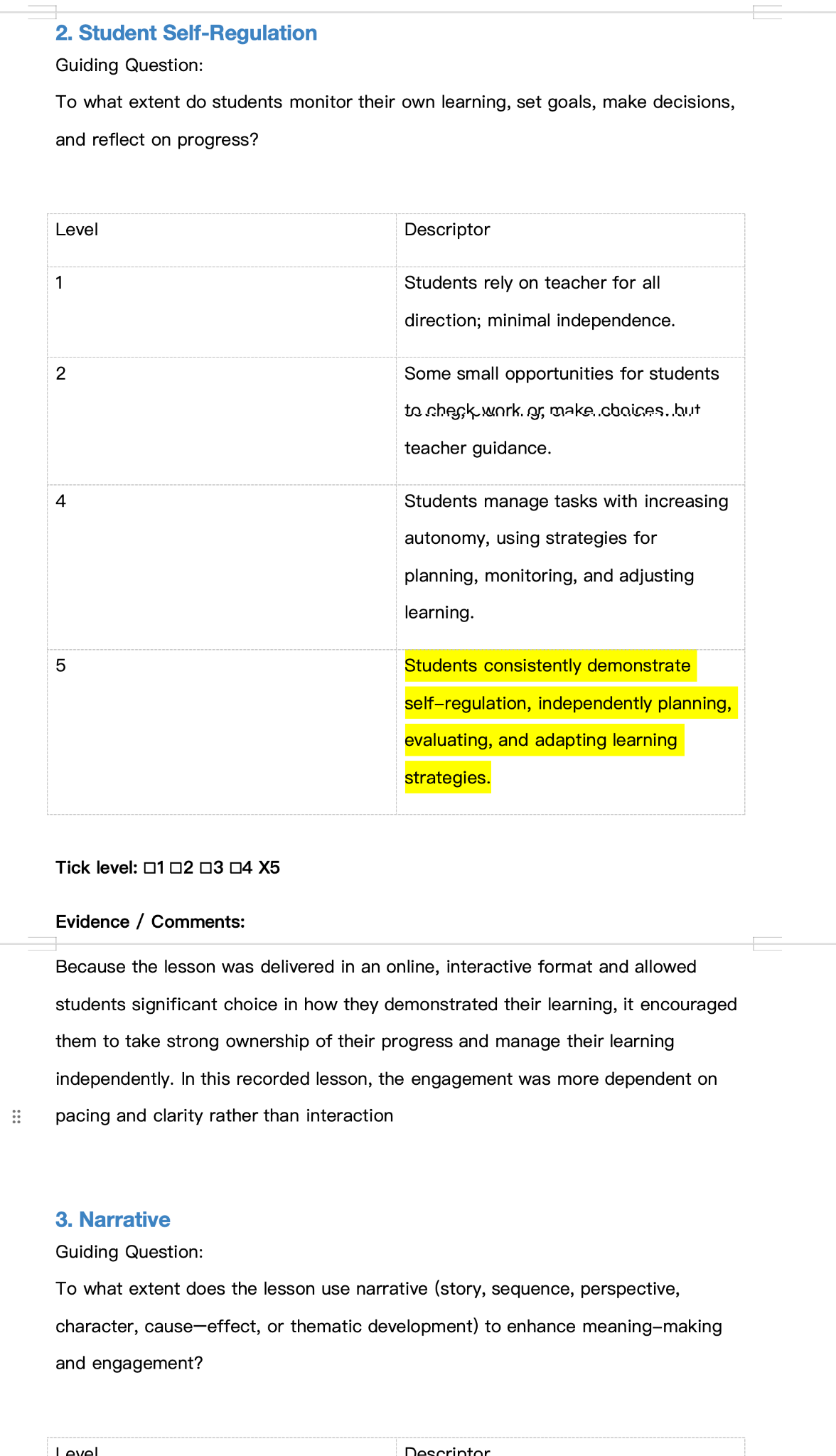
Annotation:
This peer feedback from Mitchell confirms a key limitation identified in the analysis: engagement was constrained not by motivation but by cognitive load created through rapid pacing and dense conceptual explanation. Without time to pause or consolidate during the recorded lesson, students risked shifting from active reasoning to passive viewing.
This evidence substantiates the analysis claim that engagement is highly dependent on pacing calibrated to processing needs, especially in non-interactive modalities.
Evidence 5 – Student Work Sample: Guided Notes on Silk Road Sites (Lesson 4)#
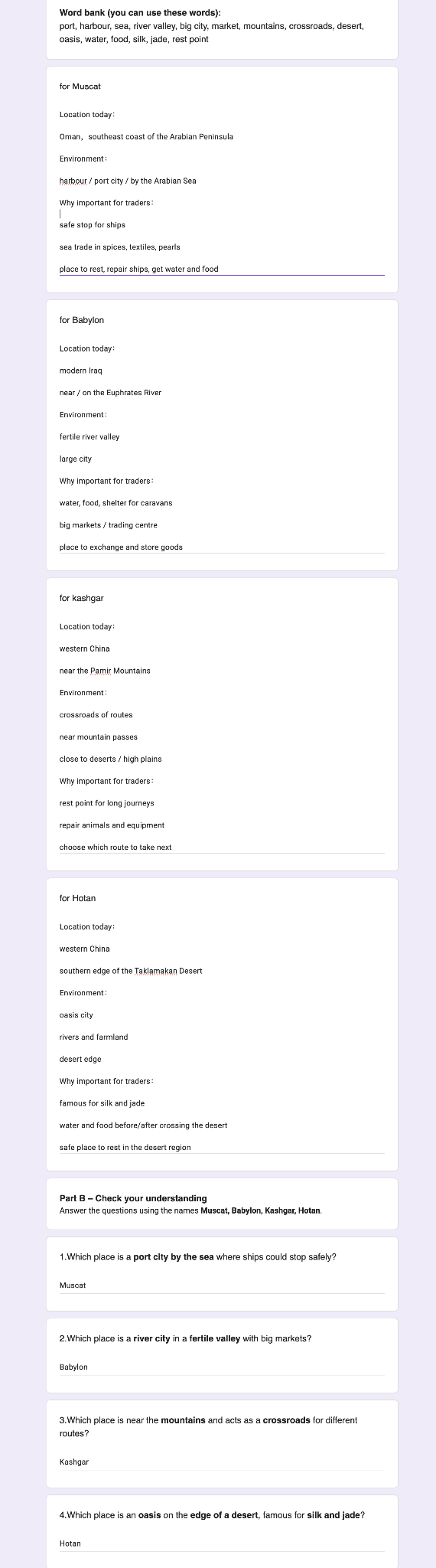
Annotation:
Only one completed Guided Notes sheet was submitted after the recorded Lesson 4, suggesting that students may have struggled to maintain engagement in a cognitively demanding and non-interactive format.
This scarcity of work samples aligns with the analysis that rapid pacing and information density limited students’ ability to process content independently, reinforcing that meaningful engagement relies on accessible pacing and built-in consolidation opportunities.
Evidence 6 – Self-Reflection Excerpt on Engagement Challenges in Recorded Lesson (Lesson 4)#
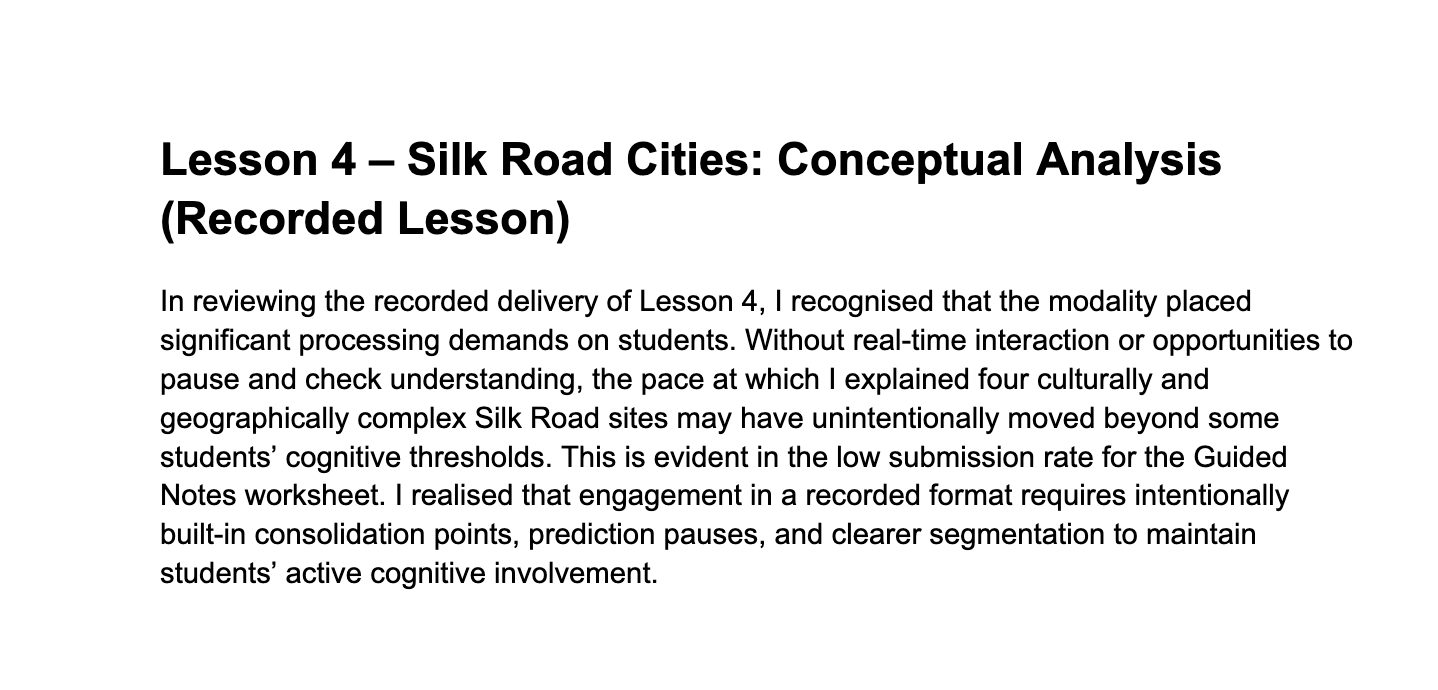
Annotation:
This reflection shows my recognition that engagement is shaped not only by student disposition but by the cognitive and structural conditions of the lesson modality.
It supports the analysis that Lesson 4’s rapid pacing and dense content challenged students’ capacity to sustain active processing, highlighting the need for deliberate pacing scaffolds and interaction points in recorded lessons.