Intellectual Quality – Deep Understanding#
Across Lessons 1 and 4, I aimed to support students in developing Deep Understanding by helping them move from isolated factual recall toward building coherent conceptual frameworks over time. In Lesson 1, this was enacted through explicit teaching that modelled reasoning from everyday logic toward historical abstraction (Evidence 1). Beginning with the prompt, “If you want to grow an apple tree, what do you need?” activated students’ prior knowledge about environmental conditions and provided an accessible cognitive bridge to later reasoning about the Mediterranean climate. Video analysis shows that several students progressed from listing environmental features to articulating causal connections between climate, agricultural productivity and Roman prosperity (Evidence 2). This shift indicates early evidence of discipline-appropriate explanation, where geography was no longer treated as an incidental detail but as a driving factor shaping societal development.
However, my questioning pattern limited the depth of inferential reasoning that could have emerged. Much of my questioning relied on convergent prompts, and the recording shows that I occasionally accepted short, correct answers without pressing students to justify or extend their thinking (Evidence 2). This reduced opportunities for students to make generalisations and construct broader causal chains. To strengthen future practice, I will intentionally incorporate wait-time, prediction questions and requests for elaboration to encourage students to verbalise deeper explanatory reasoning rather than remaining at the level of recall, as I identified in my own written self-reflection (Evidence 4).
Lesson 4 further extended students’ conceptual development by applying a consistent analytic structure—location, environment and trade function—to the four Silk Road cities of Muscat, Babylon, Kashgar and Hotan (Evidence 3). This repeated framework enabled students to identify patterns across diverse geographical contexts rather than treating each site as a discrete case. The worksheet required students to classify information, analyse environmental determinants and justify the economic significance of each location, and students’ responses in Part B (e.g., “Kashgar is a crossroads near mountains”) demonstrated emerging generalisation across contexts (Evidence 3). However, the recorded delivery meant that my explanations often preceded student reasoning, limiting opportunities for hypothesis generation and independent conceptual processing, which I later critiqued in my self-reflection (Evidence 4). In future online lessons, I will incorporate structured pauses, self-prediction prompts and brief reflection windows before presenting explanations. These deliberate moments of cognitive space will allow students to take greater ownership of the reasoning process and deepen their understanding of the conceptual relationships underpinning the Silk Road (Evidence 4).
Intellectual Quality – Substantive Communication#
Lesson 3 created sustained opportunities for Substantive Communication because the Minecraft task required students to jointly interpret meaning, justify decisions and construct shared understandings (Evidence 5). Rather than engaging in short or procedural exchanges, students had to make sense of ambiguous NPC dialogue and defend their keyword selections to group members. This pushed their communication toward interpretive, explanatory talk rather than simply agreeing on surface-level features. Video evidence shows several instances where students built on each other’s ideas and negotiated which historical concepts were most relevant, demonstrating co-construction of meaning—a key marker of Substantive Communication (Evidence 5).
The collaborative structure, even though adapted due to technical limitations, amplified the need for academically focused dialogue. With only two devices, students were required to collectively track environmental clues, question interpretations and justify why certain Bingo terms aligned with the historical context. The completed Bingo sheets show negotiated keyword choices that reflect this shared reasoning rather than individual guessing (Evidence 6). This meant that meaning-making emerged through dialogue, rather than being individually completed. The whole-class sharing phase further deepened this communication: students were expected to convert fragmented keywords into coherent historical statements, prompting them to articulate reasoning, demonstrate conceptual links and publicly defend their interpretations (Evidence 7).
However, the lesson also revealed constraints. The limited number of devices unevenly distributed cognitive responsibility, leading some students—particularly quieter and EAL/D learners—to take passive roles. Analysis of the recording shows that dominant voices sometimes steered the discussion without fully incorporating others’ reasoning (Evidence 5; Evidence 7). Additionally, a portion of student talk drifted into procedural instructions, which diluted opportunities for sustained interpretive dialogue.
To strengthen Substantive Communication in future iterations, I would provide each student (or pair) with a device or rotate smaller focus groups to allow more active engagement with the task. Introducing structured group roles and sentence stems would ensure equitable participation and maintain academically focused communication. Slow pacing during the sharing phase and incorporating peer-challenge prompts would further enhance the depth and quality of students’ explanatory talk. These planned adjustments are informed by my peer’s feedback that highlighted strong but sometimes unevenly sustained academic dialogue (Evidence 8).
Evidence#
Evidence 1 – Lesson 1 Video Snippet (Explicit Teaching Sequence)#
Annotation:
Shows how everyday reasoning was used to scaffold students toward conceptual links between climate, agriculture, and Roman prosperity. I modelled how Mediterranean climate, fertile Latium soils, and access to rivers and sea routes contributed to Rome’s economic development, helping students build causal understanding.
Evidence 2 – Lesson 1 Video Snippet (Student Verbal Reasoning)#
Annotation:
Demonstrates students articulating causal explanations about how geographical factors shaped Roman agriculture and economy. Their responses, combined with my feedback prompts, show emerging conceptual coherence about why Rome became prosperous in the ancient world.
Evidence 3 – Lesson 4 Worksheet Screenshot (Part A/B)#
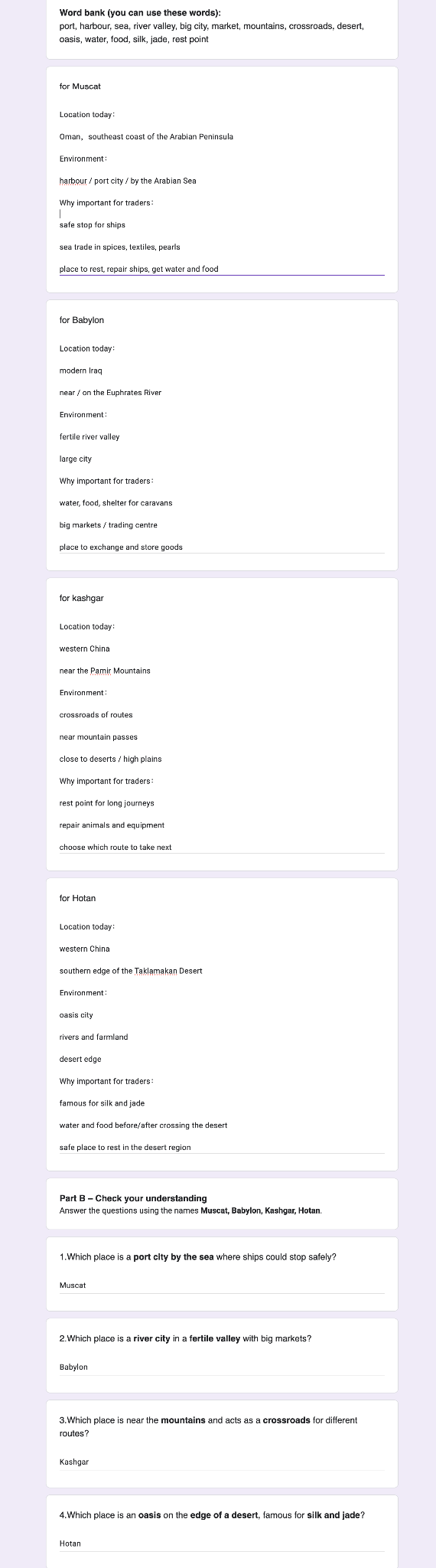
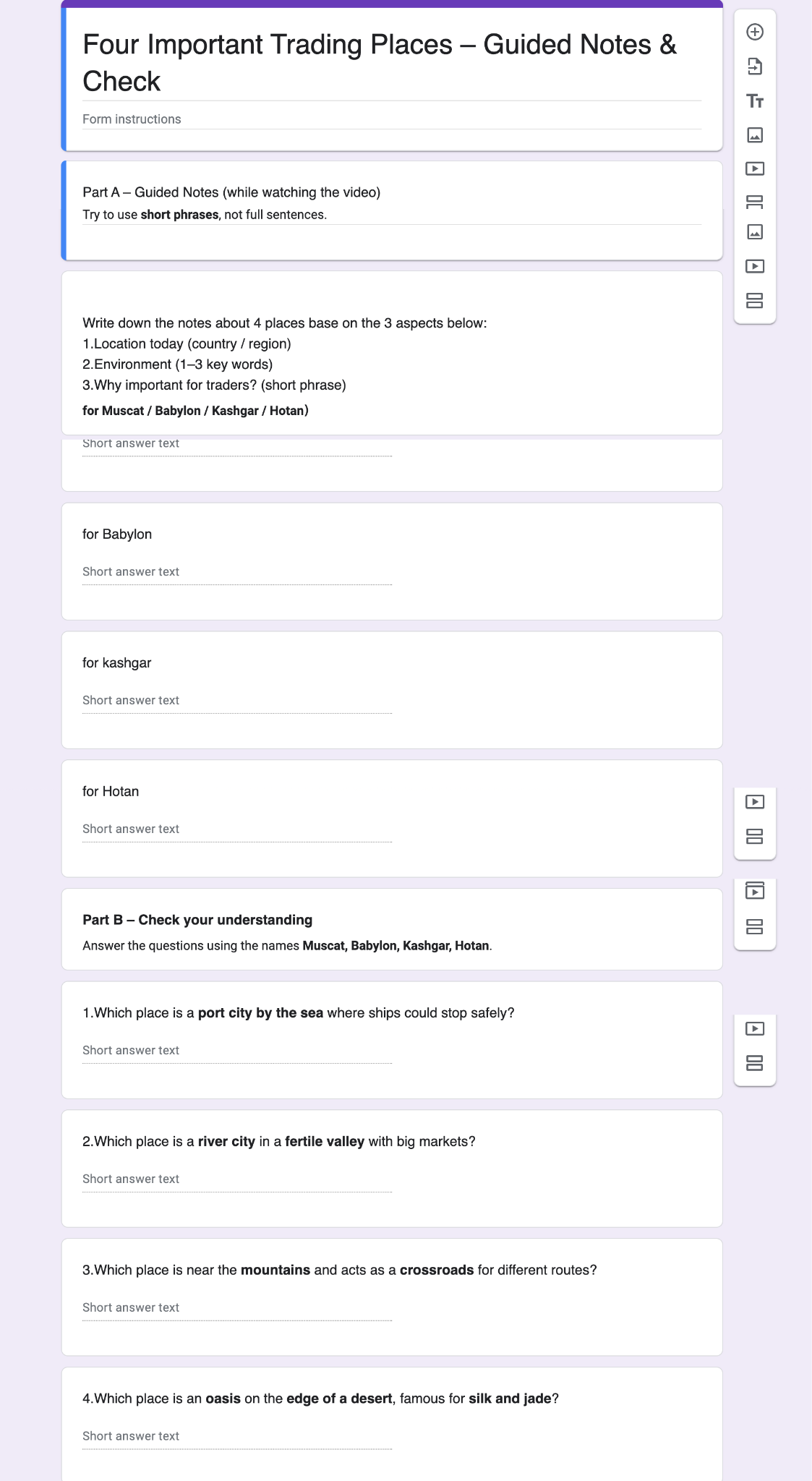
Annotation:
Shows students identifying recurring geographical patterns across four Silk Road cities. Drawing on explicit teaching, students successfully recalled and organised key information, demonstrating strengthened content retention and expanding their knowledge base.
Evidence 4 – Self-Reflection Excerpt (Lessons 1 & 4)#
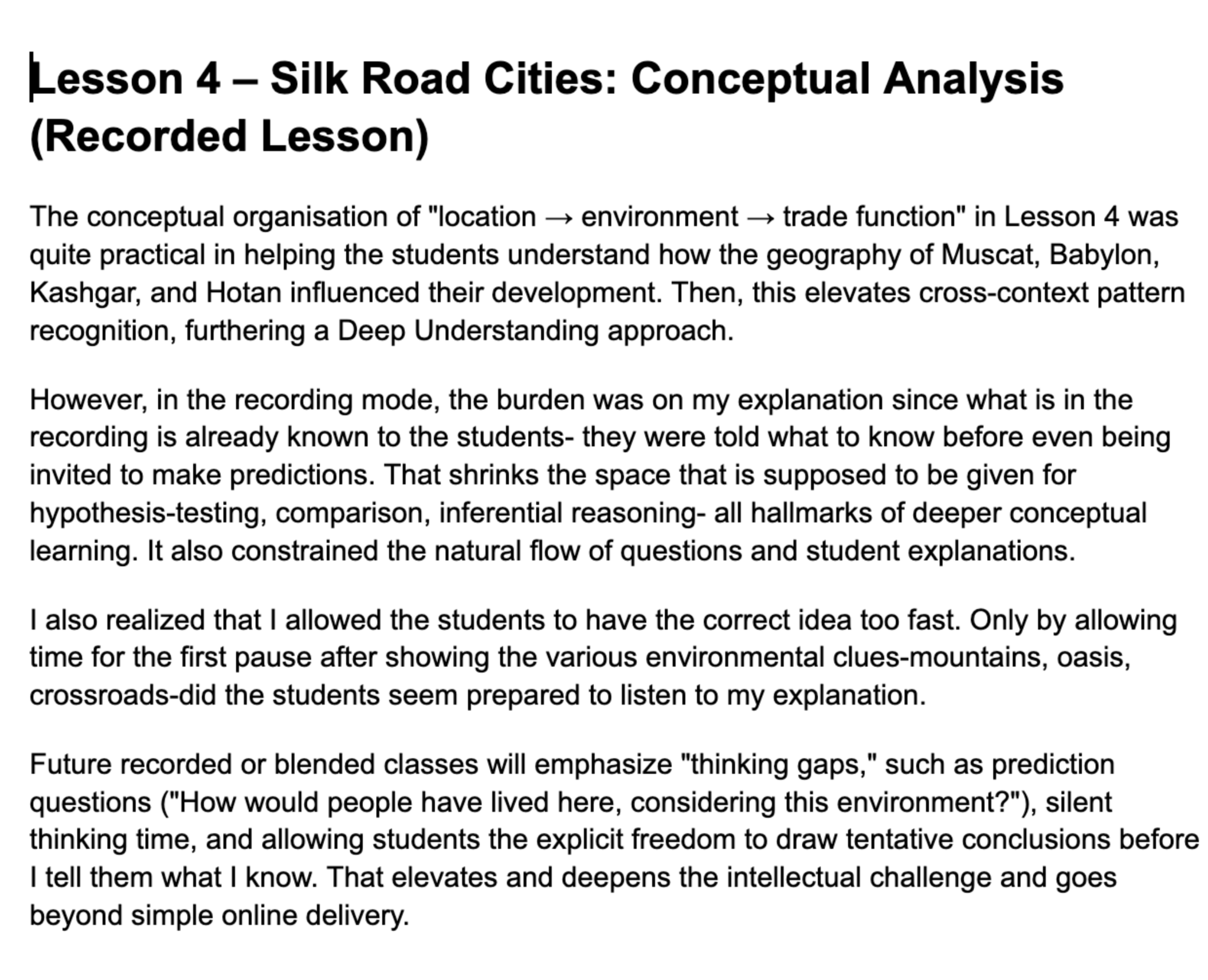
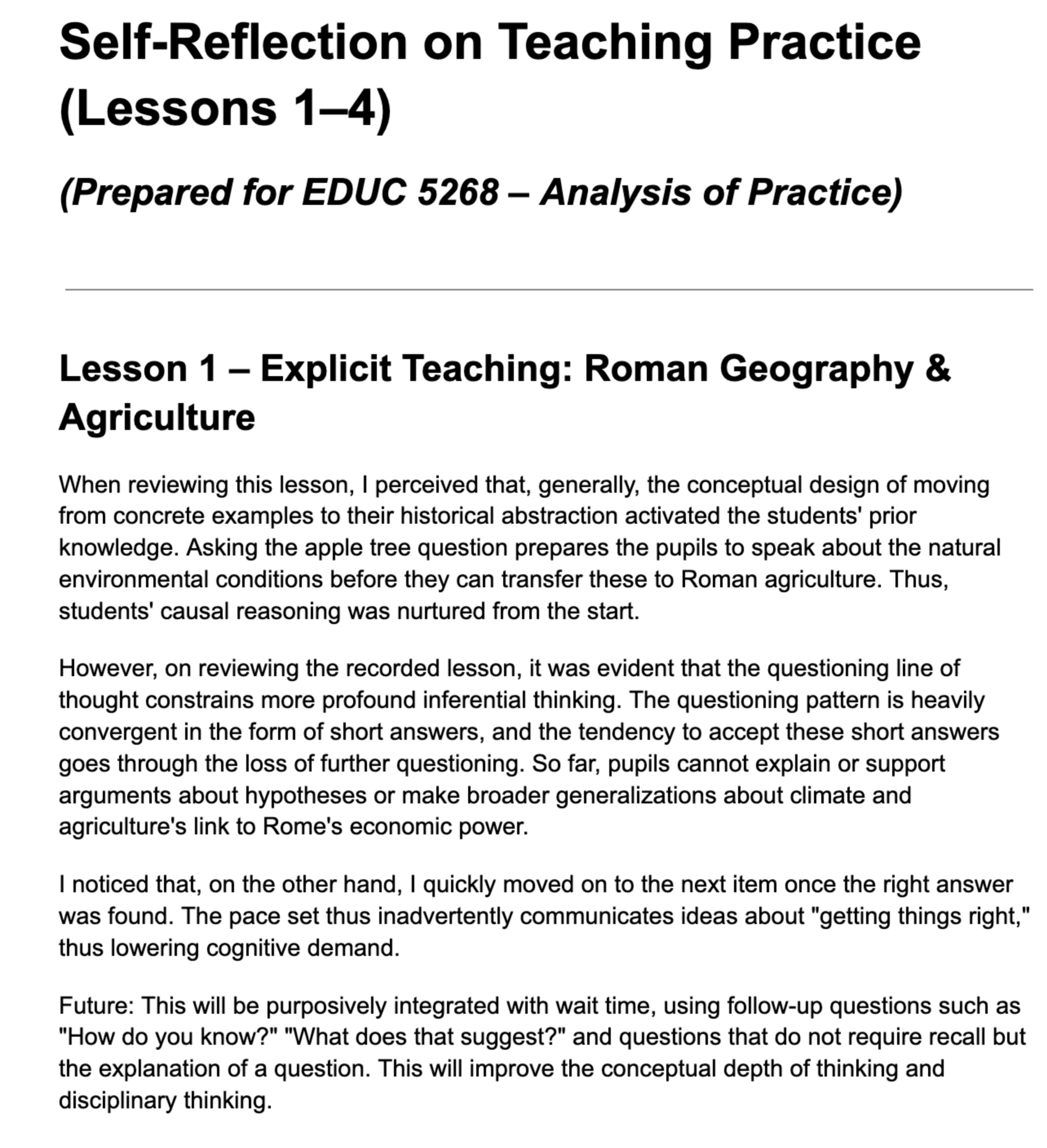
Annotation:
Documents my recognition of limits in questioning patterns and the need to increase inference-based prompts. These reflections highlight deliberate adjustments across micro-lessons to enhance teaching presence and improve future pedagogical practice.
Evidence 5 – Lesson 3 Video Snippet: Group Interpretive Dialogue During Minecraft Exploration#
Annotation:
Shows students collaboratively interpreting historical features within Minecraft. Their reasoning emerged through dialogue, requiring justification of viewpoints. This demonstrates that communication served as the mechanism through which historical understanding was built.
Evidence 6 – Lesson 3 Screenshot: Completed Group Bingo Sheet#
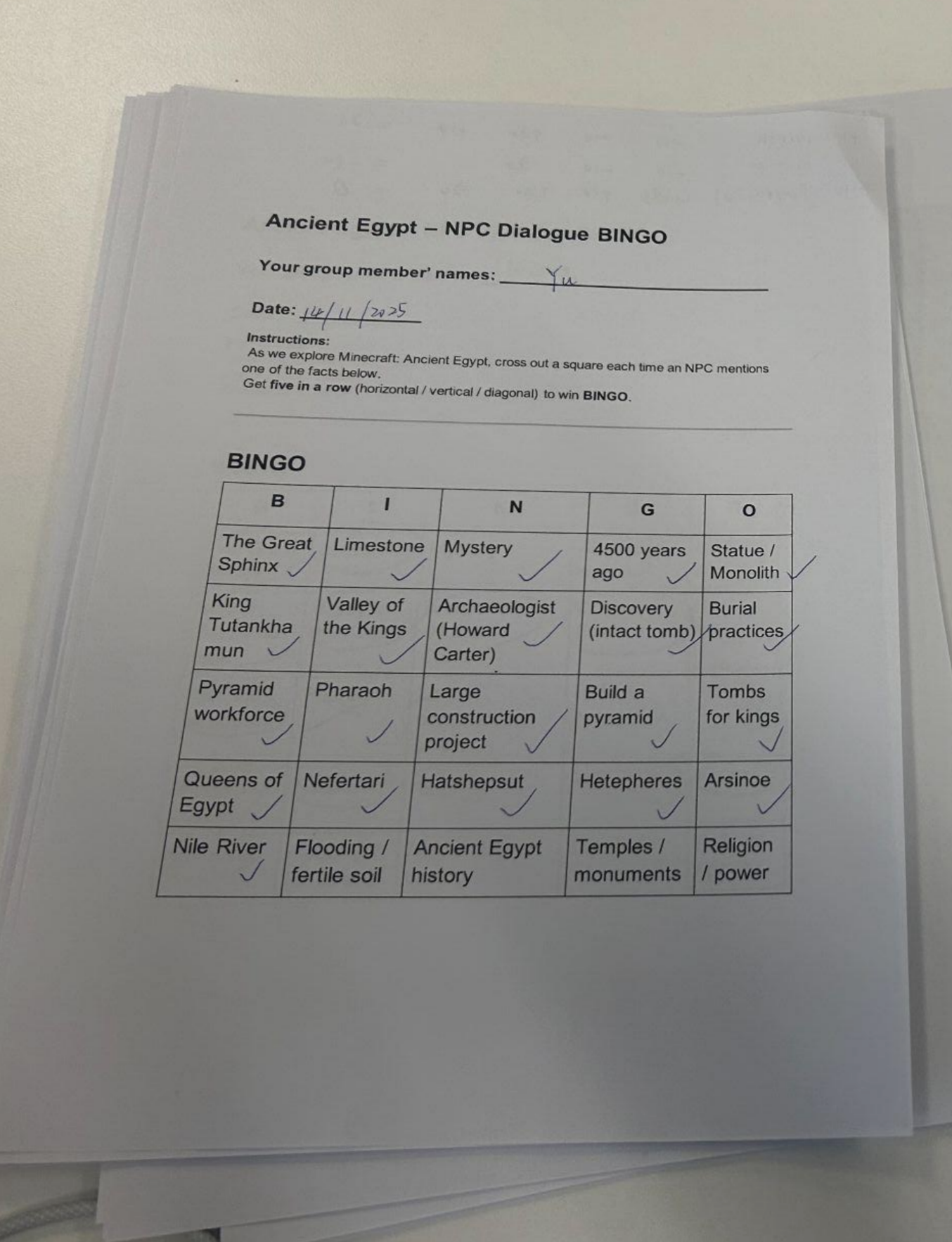
Annotation:
The negotiated keyword choices on the Bingo sheet reflect collective meaning-making rather than individual guesses. Students articulated reasoning and defended interpretations, providing strong evidence of academic, concept-focused discussion.
Evidence 7 – Lesson 3 Video Snippet: Whole-Class Reconstruction of Historical Statements#
Annotation:
Shows groups transforming selected keywords into extended historical statements. Students justified interpretations publicly, extending Substantive Communication from small-group dialogue into whole-class reasoning.
Evidence 8 – Lesson 3 Peer Feedback Excerpt#
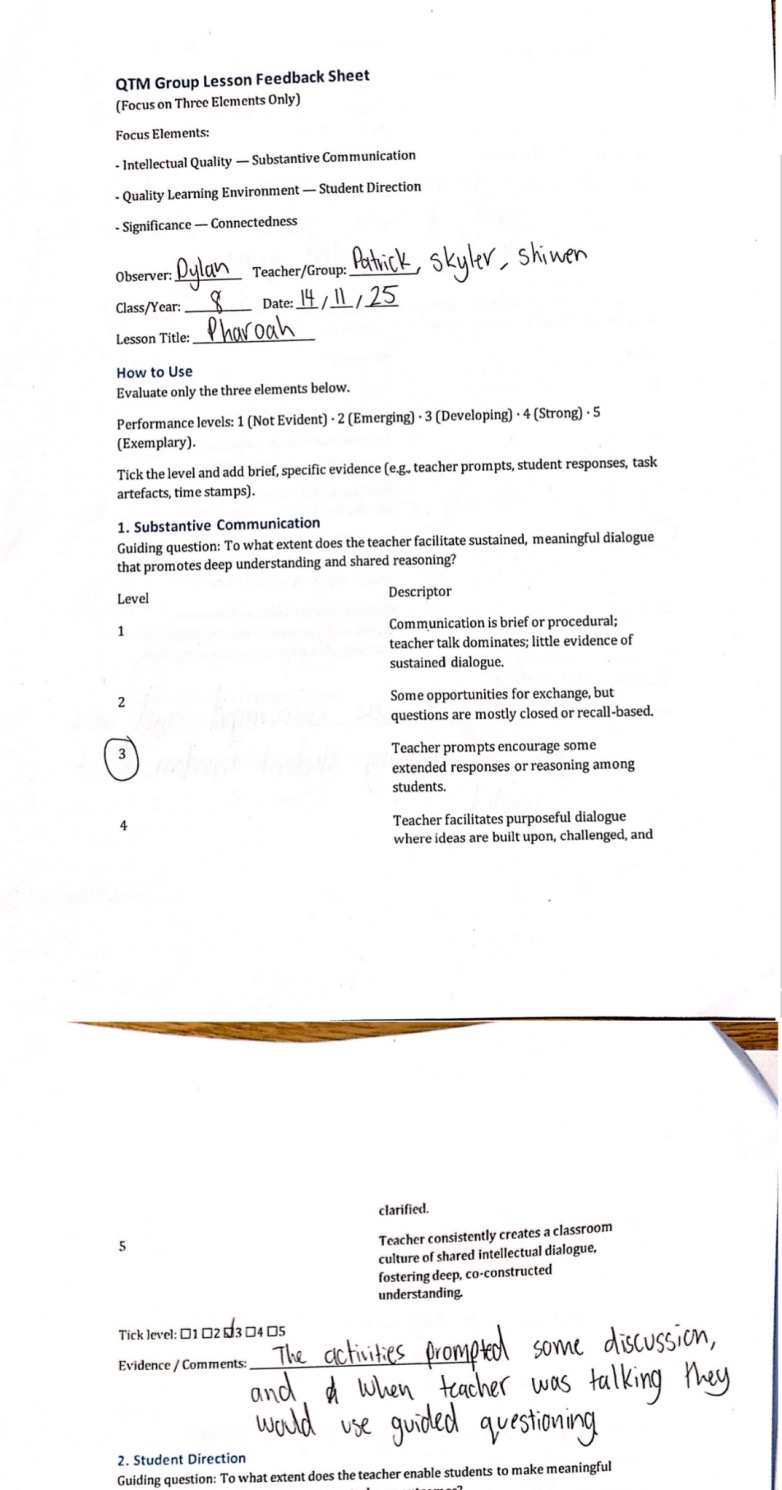
Annotation:
Peer feedback (Dylan) noted that the task generated academically focused discussion rather than procedural talk. The feedback validates that students used collaborative reasoning and that my questioning supported but did not dominate the meaning-making process.